This week I had four mentoring conversations. Four different developers from Latin America, different cities, different stages, different backgrounds. They all asked me the same three things.
I’m not exaggerating. By the fourth call I was laughing about it. Same questions, almost same order:
- How did you learn English?
- How did you get a remote job at a US company?
- How do I get visible?
So I’m writing this once. For them and for the next person who books a call.
How I learned English
I studied at the Britanico in Lima until intermediate 6. Never finished. I could barely hold a conversation. I couldn’t read a technical book. I couldn’t follow a podcast.
In 2020, during the pandemic, I decided to go all in. Full immersion. I changed my phone to English, my OS to English, everything. I started reading programming books in English. The first one took me 30 minutes per page. I didn’t understand a single sentence. Every two seconds I was looking up a new word.
But I kept going.
I tried to cover all four areas at once: reading, writing, speaking, listening. Like how a kid learns a language. Not one skill at a time. Everything at once, messy and uncomfortable.
For reading, I forced myself through technical books until it became natural. For listening, I watched podcasts with subtitles first, then without. At the beginning I couldn’t understand word by word. I trained myself to catch key words and piece together the main idea. That’s enough at first. You build from there.
For speaking, I talked out loud to myself. Constantly. I’d read paragraphs and repeat them, trying to match the intonation of native speakers. Not just the words. The rhythm, the melody of how they talk. Because you can repeat something like a robot and still not understand it. When you can add the right intonation, that’s when you actually get it.
The biggest unlock was a phonetics course on Platzi. They taught me the IPA (International Phonetic Alphabet). Where your tongue goes, when your throat vibrates, the mechanics of each sound. I recorded myself reading a text before the course and after. The difference was massive. After that I could open a dictionary, read the phonetic transcription between the slashes, and know exactly how to pronounce a word without pressing play. That’s a superpower.
For writing, I forced myself to write in Obsidian, in Markdown, in English. Writing in a second language shows you the gaps. You discover phrases you use daily in Spanish that you have no idea how to say in English. That friction is the learning.
Then came the real test. I started applying to jobs that required English. My first interview went okay for someone who had literally never spoken English with another human before. But when you talk to a native speaker for the first time, that’s the prueba de fuego. That’s where you find out if your self-taught English actually works in the wild.
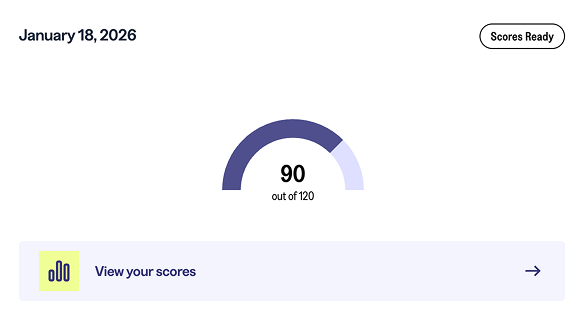
I took the TOEFL in January this year. Scored 90 out of 120. B2 level. First formal exam I ever took. Everything before that was self-taught and self-validated through interviews.
My English method, summarized
- Change everything to English (phone, OS, browser, IDE)
- Read technical books out loud, even if it takes 30 min per page
- Watch podcasts with subtitles, then without. Catch ideas, not words.
- Learn the IPA. Read phonetic transcriptions. Know how sounds work.
- Write daily in English (Obsidian, commits, tweets, everything)
- Take every interview opportunity. Even if you think you’ll fail.
My advice: if you get an interview in English, take it. Even if you think you’ll fail. Even if you feel incapable. Everything counts as experience. Everything stacks.
How I got a remote job at Clerk
2025 was chaotic. I changed jobs three or four times. I was at Globant working for Disney Streaming, then moved around. After winning the Next.js Global Hackathon I got some visibility in the community and that opened doors.
Before all that, I had applied to Supabase. Design Engineer role. Dream job. Four interview stages: HR, Founding Designer, Tech Lead, CEO. I made it to stage two. The Founding Designer was in Singapore, I was in Lima. My interview was at 8 PM, his was 7 AM. The evaluation was world class. I failed on one aspect, analytics, and it cost me the process.
It hurt. A lot. Supabase was a company I genuinely admired and I had always wanted to work at a Silicon Valley company. But I took the lessons and moved on.
Around the same time, I was building an open source library called Elements . Full-stack shadcn components. Back then, everyone was launching beautiful UI libraries but nobody went beyond the frontend. shadcn lets you distribute not just React components but also routes, environment variables, full configurations. So I went further. I connected third-party providers: Uploadthing, Supabase, Neon, and Clerk.
I shipped it. I tweeted about it.
That tweet got 1,300 likes and 134K impressions. And it reached the right person.
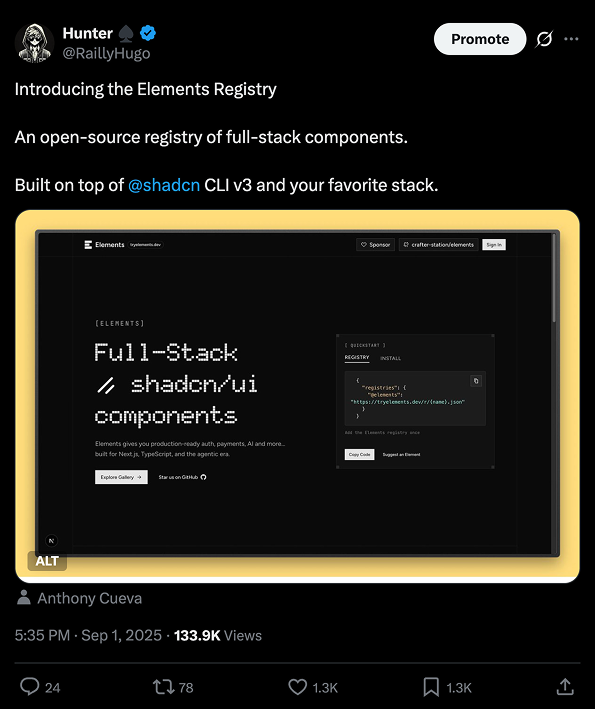
My now-boss sent me a DM on Twitter. He liked what I’d done with the Clerk integration. He shared a private API gist of something similar they were building internally. Then he told me they were putting together an AI team, AI Enablement, to make Clerk the default auth choice in the LLM era.
We had a conversation. Not a traditional interview. We talked about my projects, what I’d built, how I’d built it, what I cared about. Then I talked with Kevin, who would become my coworker. Same vibe.
The next day they sent me the offer.
The timeline
Built Elements. Tweeted about it. Got 1,300 likes. My future boss saw it. DM. Conversation. Offer. All in about two weeks. No job board. No recruiter. No CV.
The thing is, I had already planned to quit everything and go full-time on Crafter Station . I was ready to bet on myself and my community. But they made an offer I couldn’t refuse. So now I’m doing both, building at Clerk during the week and building Crafter Station on the side. It’s working.
What I take from this: my boss didn’t find me on LinkedIn. He didn’t find me through a recruiter. He found me because I built something, shipped it, and shared it publicly. That tweet wasn’t a marketing strategy. It was just me showing my work.
You never know who’s watching. You might be tweeting at your next boss right now.
How do I get visible?
Every developer I talked to this week asked some version of this question. How do I get noticed? How do I build a network? How do I get opportunities without connections?
Here’s the honest answer: every job I’ve ever gotten came from events, hackathons, or someone who saw my work online. Never from a job board. Never from a cold application that actually worked.
I met my Crafter Station cofounder Anthony at the BCP hackathon. I met key collaborators at hackathons in Colombia. I met the people who would recommend me for jobs at random meetups in Lima.
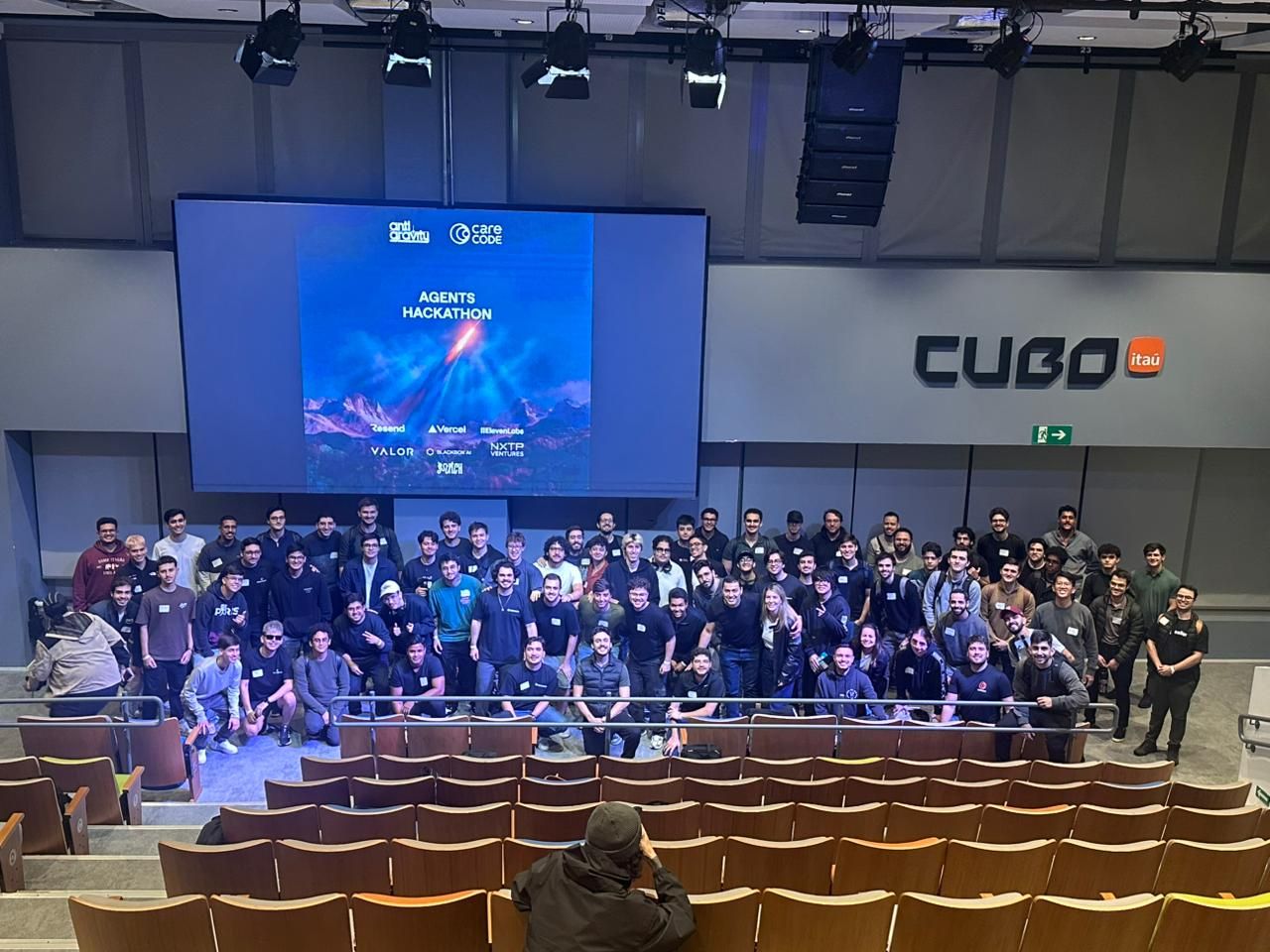
The pattern is always the same. You show up, you build something, people see it, someone remembers you later.
Building in public is not a buzzword. It’s not about followers or engagement or going viral. It’s about having something real that people can find. A GitHub profile with actual projects. A tweet showing what you shipped this week. A blog post explaining what you learned.
You don’t need 10K followers. You need one person to see the right thing at the right time.
CVs don’t work because they’re static. They list what you did, not what you can do. When someone sees your open source project, they’re seeing proof that you can ship. That’s worth more than any resume.
What they told me after our calls
“It was like paying a lot of money for a consulting session. It helped me see clearly what I needed to do with my startup and gave me a push to launch now.” — Phil Taboada , founder of Wavys
“I left the conversation with much more clarity and confidence. It helped me see that I do have potential, but above all, to understand how to focus it and sell it better.” — Harold Medrano , navigating a career transition
So: go to meetups. Enter hackathons. Tweet about what you’re building, even if nobody likes it. Especially if nobody likes it. Consistency compounds.
If you’re reading this
I talk to developers every week. Free, 30 minutes. If you’re in Latin America building something and want to talk about English, remote work, or getting visible, book a conversation .
I’m not an expert. I’m just someone who figured out a few things the hard way and is happy to share the receipts.